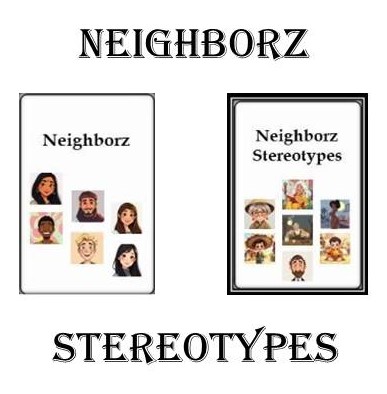
Hey all, short hiatus but I’m back. In fact, I’ve got a new game to share with you all. While work continues on Warhold (just making the .stl files for the playing pieces then it’ll be ready to go to the manufacturer for a prototype) I thought I’d push out a smaller, easier-to-manage game.
Welcome to Neighborz! This is a simple card game that invokes elements of 7-Up (for those of you who know that card game) and Uno. However, it’s centered around building families as they move into the neighborhood. I’ve posted the rules below for your perusal along with a few pics. The game is with the manufacturer at the moment, and a finished prototype will be on its way in a short period of time.
Along with the main game, which is geared towards children (and can even be used to learn family names with children learning English as a second language), you can find Neighborz: Stereotypes. This version is a little more PG and contains a series of ridiculous stereotypes about various races. Much more fun than the original, with a slew of in-game rules that trigger when specific cards are played or when an entire family has moved into the neighborhood, Neighborz: Stereotypes is a great game to play with your friends in between games of Cards Against Humanity.
Here are the rules:
Neighborz
A Card Game
Welcome to Neighborz: A Card Game. Six families are moving into the neighborhood and will need your help to get settled. In this game you will build families, burden your competitors and race to be the first player with no cards left in their hand. The first person to have no cards in hand is the winner.
How to Play
Who goes first?
Anyone can go first. Generally it is best for the person to the left of the dealer to go first, however, you can decide who goes first however you like.
In Neighborz each player is dealt seven cards. When it is your turn you may play one of the cards in your hand. If you are unable to play a card in your hand you must draw a card from the deck. You may play the card you draw if able.
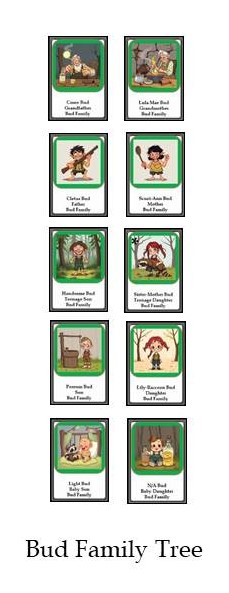
Each family has ten members: a grandfather, grandmother, father, mother, teenage daughter, teenage son, daughter, son, baby daughter and baby son.
Each family is identified by the color backing the member’s pictures.
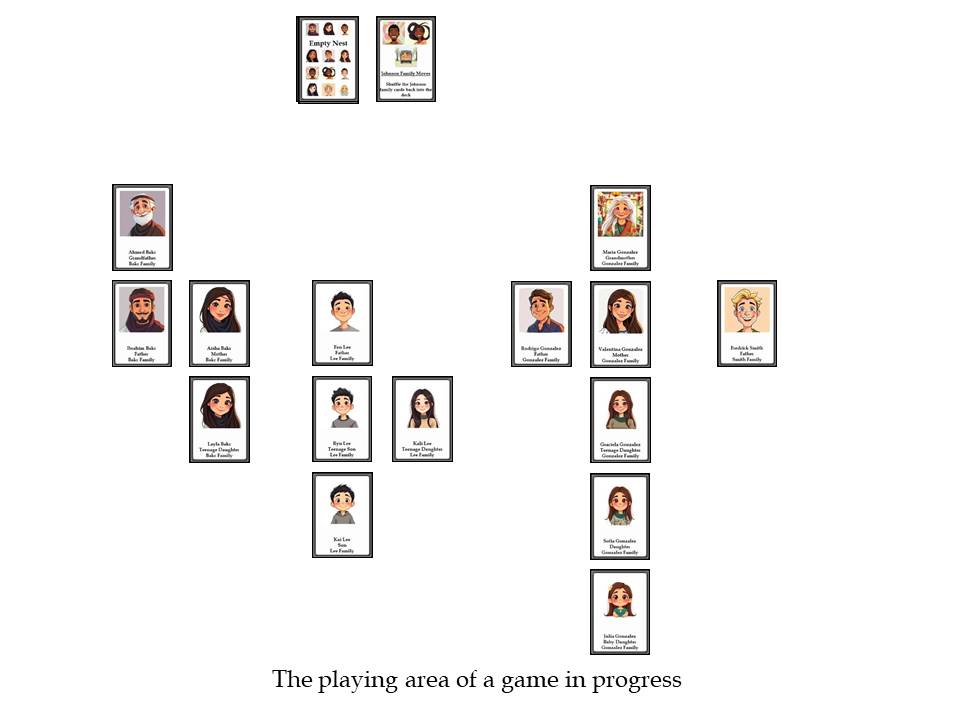
To start building a family an adult (father, mother, grandfather or grandmother) card must be played. After an adult card has been played other players can build upon the family with adjacent family members. Players may only place adjacent family members – if the grandfather card is played this means that the mother card will no longer be able to be played, only the father and grandmother cards.
The order of the family, from top to bottom, goes: grandmother–mother–teenage daughter–daughter–baby daughter on the female side of the family and grandfather–father–teenage son–son–baby son on the male side.
If a mother card has been played for one of the families then other players can play the grandmother, teenage daughter or father cards for that family. Whenever a male/female card of the family has been played the corresponding card on the other side can be played.
For example: The Johnson family has both the mother and father cards played as well as the teenage daughter and daughter cards. At this point players may play either of the grandparents, the baby daughter, the teenage son or son cards. The son card can be played even if the teenage son card has not been played because the corresponding female card (daughter) has been played.
Players may start a new family at any time by playing a mother/father card.
Aside from the family member cards there are also a number of additional cards, such as ‘Unplanned Pregnancy’. These cards may be played during your turn instead of a family member card. These cards are played by adding them to a discard pile next to the deck.
If a player is able to play a card they must play a card. A player may not choose to draw a card if they have a card that can be played. A player may not choose to hold onto a card they drew if it is able to be played. Cards that have no effect (cards that force a player to pick up cards if the deck is exhausted) can still be played as normal, they just have no effect.
When a player plays their second-to-last card they must say ‘Last Card’, thereby alerting the other players that they are on their last card. If a player with only one card does not say ‘Last Card’ before the next player plays their turn any other player may call out the player who failed to declare they were on their last card. The player who didn’t say ‘Last Card’ must pick up two cards at this point. When a player plays their last card they win the
Neighborz: Stereotypes
A Card Game
Disclaimer: Neighborz: Stereotypes is not intended or designed to offend. Rather, it aims to demonstrate the ridiculousness of holding onto antiquated stereotypes of people from other races, religions, countries and lifestyles. For those who are easily offended, or overtly sensitive, this game may not be for you.
Welcome to Neighborz: Stereotypes. Seven families, of very diverse backgrounds, are moving into the neighborhood. It’s your job to help them get settled. In this game you will build families, burden your competitors and race to be the first to play all the cards in your hand. The goal of the game is be the first person to play every card in your hand. The first person to have no cards in hand is the winner. All of this will be done while engaging with the most iconic stereotypes of each family. How dare you!
How to Play
Who goes first?
Before the cards are dealt deal each player one card face up. Continue to do this until the white father (Cletus Bud) is drawn. The player who draws him goes first after the cards have been dealt. Alternatively, if the black mother (Letisha Johnson) is drawn, that player goes last and the player to their left begins the game. Once one of these two cards have been shown shuffle all the cards back into the deck and deal the cards to start the game. Alternatively, you may choose to have the person to the left of the dealer begin the game after the cards have been dealt.
In Neighborz: Stereotypes each player is dealt seven cards. When it is your turn you may play one of the cards in your hand. If you are unable to play a card in your hand you must draw a card from the deck. You may play the card you draw if able.
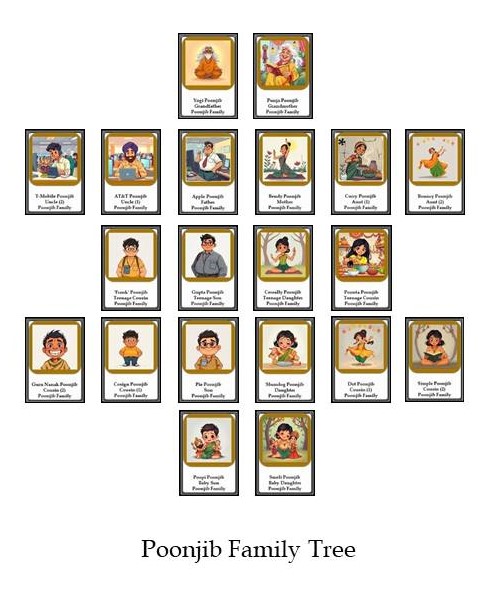
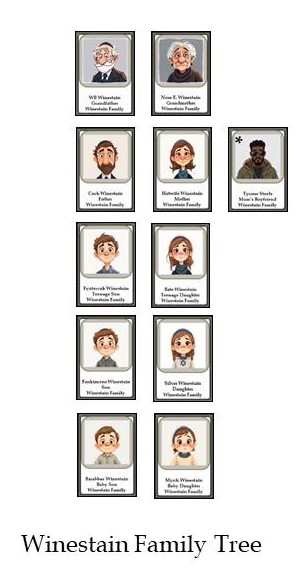
Each family has a different number of members. The Bud family has ten members, although their exact relation to each other is often in question. The Winestain family has ten family members plus Mom’s boyfriend, whom she cuckolds her husband with. The Steels family only has 8 members because their father, and his father before him, has run out on them. The Poonjib family has 20 members – the original 10 plus 2 uncles and aunties and several cousins, they are the largest family. The Chimichanga family has 16 members, with an extra child of each age. The Durka family has 10 members, although two of them are, technically, ghosts after blowing themselves up in the name of their cause. Finally, the Chin family only has 7 members – because with Asians once you have a male child you stop having children. Each family is identified by the color backing the member’s pictures.
To start building a family an adult (father, mother, grandfather or grandmother) card must be played. After an adult card has been played other players can build upon the family with adjacent family members. Players may only place adjacent family members – if the grandfather card is played this means that the mother card will no longer be able to be played, only the father and grandmother cards. In the case of the Winestain family ‘Mom’s Boyfriend’ may NOT start the family.
The order of the family goes: grandmother – mother – teenage daughter – daughter – baby daughter on the female side of the family and grandfather – father – teenage son – son – baby son on the male side of the family. Aunts, uncles, cousins and second sons or daughters of the same age are placed adjacent to these members. For example: teenage daughter (1) must be placed before teenage daughter (2) can be placed unless being placed adjacent to daughter (2). Each of the family trees are shown below for further clarification.
If a mother card has been played for one of the families then other players can play the grandmother, teenage daughter or father cards for that family (or auntie/mom’s boyfriend for the corresponding families). Whenever a card for one side of the family has been played the corresponding card on the other side can be played.
For example:
The Chimichanga family has both the mother and father cards played as well as one teenage daughter and both daughter cards. At this point players may play either of the grandparents or the teenage son (1) or son (1) cards as well as the teenage daughter (2) or either baby daughter cards. The son card can be played even if the teenage son card has not been played because the corresponding female card (daughter) has been played. The same is true of the baby daughter (2) card – it can be placed because it is adjacent to the daughter (2) card.
Players may start a new family at any time by playing an adult card.
Aside from the family member cards there are also a number of additional cards, such as ‘Caught Masturbating – The Next Player Misses a Turn’. If you are unable to play a family card you may play one of these cards. These cards are played by adding them to a discard pile next to the deck.
If a player is able to play a card they must play a card. A player may not choose to draw a card if they have a card that can be played. A player may not choose to hold onto a card they drew if it is able to be played. Cards that have no effect (a card that forces a player to pick up cards if the deck is exhausted) may still be played, they just have no effect.
Some of the family cards also have special rules, as do completed families. The individual cards that have special rules are marked with ‘*’ in the top left corner. As shown below:
The rules for these cards (as well as the family specific rules) can be found here.
Specific Card Rules
Sister-Mother Bud (Teenage Daughter) – Confusion over whether Sister-Mother is your mother or sister has you confused about the acceptability of marrying her (you can marry your sister but not your mother). When this card is played choose a player, they miss their next 2 turns.
Cartel Chimichanga (Teenage Son (2)) – Cartel is engaged in a lively human trafficking trade and is always on the lookout for easy marks to pad his pockets with. When this card is played choose any 5 family cards that have been played and shuffle them into the deck. They can all be from one family or from different families.
Mie Chin (Son) – Boys are more preferable than girls when having a child. When this card is played take all the female children (teenage daughter, daughter, baby daughter, teenage cousin, cousin, etc.) and shuffle them back into the deck.
Mohammed Durka (Teenage Son) – Following in his father and grandfather’s footprints Mohammed is ready to sacrifice himself for the cause. When this card is played remove any Winestain family members that have been played and shuffle them back into the deck. If there are no Winestain family members in play instead choose another family to remove from play and shuffle into the deck.
Curry Poonjib (Aunt 1) – This auntie fancies herself a great cook, and though her food may taste good the smell is enough to drive an entire family from the neighborhood. When this card is played removed all family members of the families played on either side of the Poonjib family and shuffle them back into the deck.
EZ Steels (Teenage Daugher) – EZ is the sexiest girl on the block, and loves to flaunt it. No matter where she goes she causes a rush of blood from men’s heads to their…other head. Even grandpas and newborn babies are affected by EZ’s allure. When this card is played no player may play a male card, of any type, for 2 complete rounds – all the men are too busy trying to get EZ’s attention to help settle their family in their new home.
Tyrone Steels (Mom’s Boyfriend) – When Tyrone hits the scene husbands everywhere go insane with jealousy. Cuck Winestain in particular cannot control his rage and takes it out on the next person who comes into his bank to refinance their loan – which he inevitably refuses, causing a family to lose their home. When this card is played choose a family (must be the Durka family if any members have been played) and remove any members that have been played and shuffle them back into the deck.
Completed Family Rules
Bud Family – The Bud family are have little distinction between family members and it spreads to the other families. When the entire Bud family is in play players may play family members in any order in the other families. For example: Baby son may be placed adjacent to grandmother, cousin (2) may be placed adjacent to mother and so on.
Chimichanga Family – The Chimichanga family loves nothing more than celebrations and siestas. While the entire Chimichanga family is on the board players may play two cards each turn. Alternatively, if a player cannot play a card they must pick up two cards instead of one. In this case players do not need to declare ‘Last Card’ if they can play their last two cards during their turn.
Chin Family – The Chin family prioritizes male children over females and this ‘value’ spreads to the rest of the neighborhood. When the last Chin member is placed every player may immediately place all their male family member cards (of all families) that are currently available to play, ie. have an adjacent card they can use for placement. All players must play at the same time, so only those available for play at the time the last Chin member is placed may be placed, males who could be placed based on another players male placements for this rule may not be placed.
Durka Family – Once the entire Durka has moved in the Winestain family become very nervous. After the last member of the Durka family has been played no Winestain family members may be played for two complete player rounds.
Poonjib Family – If the entire Poonjib family settles into the neighborhood the other families cannot take the stench of their cooking and decide to move out. When the last member of the Poonjib family is played remove all other families that have been played and shuffle them back into the deck.
Steels Family – If the entire Steels family is in play the property values in the neighborhood drop drastically. When the last member of the Steels family is played every player, except the player who played the last member of the Steels family, draws two cards.
Winestain Family – Once the entire Winestain family is in play Cuck and WB Winestain freeze all loans at their bank. The player who plays the last member of the Winestain family (including Mom’s Boyfriend) receives an extra turn and may play another card immediately.
When a player plays their second-to-last card they must say ‘Last Card’, thereby alerting the other players that they are on their last card. If a player with only one card does not say ‘Last Card’ before the next player plays their turn any other player may call out the player who failed to declare they were on their last card. The player who didn’t say ‘Last Card’ must pick up two cards at this point.
When a player plays their last card they win the game.





🔗 🚨 Critical: 0.8 Bitcoin transfer failed. Retry now > https://graph.org/Get-your-BTC-09-04?hs=6c2cd2629371fc06f524a074739119e8& 🔗
October 10, 2025 — 10:31 pm
uynsbe